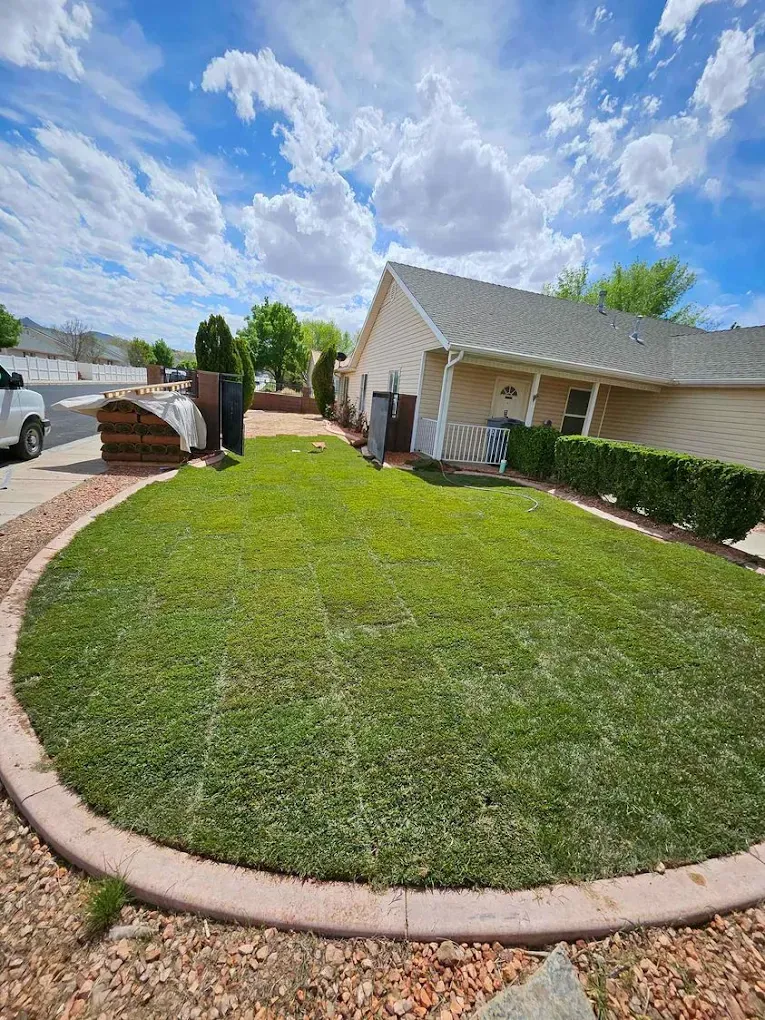
Sod will root in Saint George almost any month of the year. There is exactly one month where you should not try, and it is the month most people call us.
There is a short answer to this one. USU Extension's turfgrass management calendar for St George says sod can go down any month the soil is not frozen. Except July.
July is also, predictably, the month most people call us about a new lawn. Here is why the exception exists and how to time it properly.
Why July is the one month to avoid
Sod arrives as a living plant with its root system cut off. For the first two to three weeks it has almost no ability to draw water from the soil beneath it. It survives entirely on what you apply, held in the thin layer of soil it came with.
In a St George July, that layer dries out in hours. Peak summer soil temperature here averages around 98°F, air temperature is routinely far above that, and the evaporative demand is at its annual maximum. Meanwhile the city restricts landscape irrigation between roughly 10 a.m. and 8 p.m. in summer. Exactly the hours a new sod lawn is under most stress.
So you have a plant that needs constant moisture, in the month with the highest demand for it, during which you are not permitted to water through the worst of the day. Some people get away with it. Many replace the lawn in September.
The timing depends on which grass you are laying
This matters more than the calendar, and it is the part that gets skipped.
Cool-season grass: Kentucky bluegrass, tall fescue
Best: late summer into early autumn. USU's guidance for St George is that cool-season grasses can be seeded from mid-spring to early autumn, but late summer is optimum. Warm soil drives fast root establishment, while air temperatures are falling rather than rising.
That is the critical difference from spring. Sod laid in April has about eight weeks before it meets its first Southern Utah summer. Often not enough root depth to survive it. Sod laid in September has all of autumn, winter and spring to establish before it faces a July at all.
Second best: early spring. February through April. Workable, but it commits you to careful watering through the first summer.
Warm-season grass: Bermuda, zoysia, buffalograss
Best: spring into early summer, roughly March through May. Warm-season grasses need warm soil to establish and are effectively dormant in cool weather. Laying bermuda in October means it goes straight into dormancy without rooting, and it will sit there looking dead until spring. Assuming it survives.
This is the exact opposite of the cool-season answer, which is why "when should I lay sod" has no single correct response.
| Grass type | Best window | Acceptable | Avoid |
|---|---|---|---|
| Tall fescue / bluegrass | Late Aug - early Oct | Feb - Apr | July; deep winter |
| Bermuda / zoysia | Apr - Jun | Mar, early Jul with care | Oct - Feb |
Which grass should you actually be laying?
Worth settling before the timing question. Cool-season grass is marginal in this climate. At 98°F soil temperatures, bluegrass and fescue stop growing roots and spend July surviving rather than thriving. That is the mechanism behind the annual July lawn collapse.
- Want year-round green and will accept a hard July? Tall fescue is the most heat-tolerant cool-season option. Lay it in early autumn.
- Want a lawn that is comfortable in a Southern Utah summer? Bermuda or zoysia. Accept that it browns and goes dormant in winter. Lay it in spring.
- Not sure the lawn is worth it at all? A fair question here. In St George, Washington, Santa Clara and Ivins the water district will pay $2 per square foot to take lawn out. See the rebate guide. Keeping the part you use and converting the rest is usually the right answer.
Preparation is most of the job
Sod is the cheap part. What goes underneath it determines whether you are doing this again in three years.
- Deal with compaction. Our clay is dense, and in newer subdivisions what is on the lot is often compacted construction fill rather than topsoil. Sod laid on that roots shallowly and never recovers. It needs breaking up and amending before anything goes down.
- Grade away from the house. Obvious, frequently skipped, and expensive to correct once the lawn is in.
- Fix the irrigation first. Every head, every zone, correct coverage and correct pressure. before the sod arrives. A dry corner during establishment becomes a permanent bare patch, and you cannot fix coverage properly once there is a lawn on top of it.
- Edge it. A concrete mow curb or hard edge keeps the lawn where you put it and stops it creeping into gravel beds. It also makes maintenance faster forever.
The first three weeks
Establishment watering is different from normal watering and it is the only time frequent shallow irrigation is correct.
- Week 1: keep it consistently moist. Multiple short cycles a day, within legal hours.
- Week 2: begin reducing frequency, increasing duration.
- Week 3 onward: transition to deep, less frequent watering on cycle-and-soak, which drives roots downward.
Do not mow until the sod has knitted down. Tug a corner, and if it resists, it has rooted. First cut should take no more than a third of the blade, at 2.5 to 3 inches.
At elevation
La Verkin sits at 3,816 feet in a colder hardiness zone than the rest of the county, with a shorter growing season at both ends. Autumn sod there wants to go down earlier than in St George, so it has time to root before cold sets in. Hurricane sits between the two.
If you are planning a new lawn, we will tell you the right month for it. Including when that means waiting until autumn. It is a better conversation in June than a callback in August.
Sodding and seeding windows, soil temperature and mowing height are from USU Extension's St George turfgrass management calendar. Irrigation timing restrictions vary by city; check your own city's current ordinance.