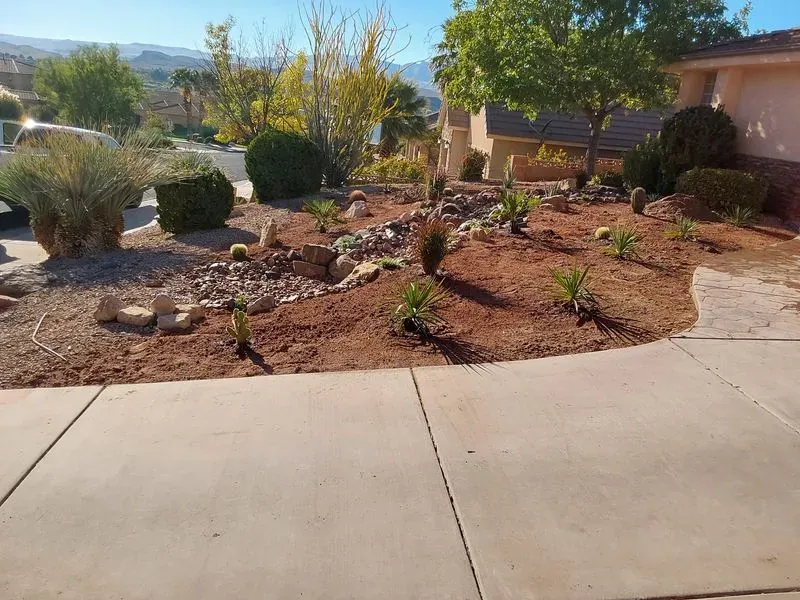
Four cities in this county will pay you to remove lawn. Two will not. Most people find out which one they live in after they have already planned the project.
The Washington County Water Conservancy District will pay you to remove living lawn. It is one of the more generous programs of its kind in the country, it has already paid out over $4 million locally, and roughly two million square feet of grass has come out since it began in December 2022.
It also does not apply to everyone in this county, which is the part people find out too late.
Who qualifies, and who does not
| City | Eligible? | Rate |
|---|---|---|
| Santa Clara | Yes | $2 + $1 city top-up (first 500 sq ft) |
| St George | Yes | $2 / sq ft |
| Washington | Yes | $2 / sq ft |
| Ivins | Yes | $2 / sq ft |
| Hurricane | No | None |
| La Verkin | No | None |
The reason is not arbitrary. The District requires a participating city to have adopted water-waste and new-construction landscape ordinances, specifically ones that cap new landscape turf at no more than 15% of lot size. Four cities have done that. Hurricane and La Verkin have not, so their properties are outside the program.
If a contractor quotes you a conversion in Hurricane or La Verkin with a rebate factored in, they have not checked.
The rates, precisely
- $2.00 per square foot for the first 5,000 square feet
- $1.00 per square foot for anything above 5,000 square feet
- Santa Clara only: an additional $1.00 per square foot on the first 500 square feet, funded by the city
That Santa Clara stack is, by the District's own description, the highest rate in Utah for removing nonfunctional turf. The city allocated around $82,000 and state matching roughly doubled it to about $164,000. Enough for approximately 320 residential projects. It is a finite pot. When it is spent the top-up stops until the city funds it again, so Santa Clara residents considering this have a real reason not to sit on it.
What you have to do to qualify
The requirements are specific and they are enforced at inspection. A gravel field with a few shrubs will not pass.
- Minimum 300 square feet of living, maintained grass removed. Dead lawn does not count. It has to be alive when inspected.
- At least 50% living plant cover at maturity, using water-efficient vegetation. This is the requirement that catches people. You are being paid to convert to a planted landscape, not to a rock field.
- Irrigation converted from spray to drip, with filters, pressure regulators, and emitters rated at 20 gallons per hour or less.
- No bare soil. Surfaces must be permeable and covered with mulch or a permeable alternative.
- Water source matters. Properties on secondary irrigation or treated wastewater are eligible. Groundwater-dependent properties are not.
Note what is not eligible: artificial turf. Synthetic grass is not living plant cover, so removing lawn and installing turf earns nothing. We go into that trade-off in the turf comparison.
The sequence. And the mistake that voids everything
- Submit the application to the District.
- Wait for the call. A District representative contacts you within about 14 business days to schedule a pre-conversion inspection.
- Pre-conversion inspection. They confirm the lawn is living and maintained and that the plan qualifies.
- Get approval.
- Then do the work. You have 12 months from approval to complete it.
- Final inspection and approval.
- Conservation easement must be executed and recorded within 18 months.
- Payment within 30 days of recording. Cheques void after 90 days. Bank it.
Do not start work before approval. This is the single most common way people lose the rebate. The pre-conversion inspection exists to verify there was living, maintained grass there. If you have already removed it, that cannot be verified, and the claim fails. Tearing out the lawn over a long weekend and applying afterwards forfeits the entire amount.
The conservation easement is a real commitment
Worth understanding before you apply, because it is a legal instrument recorded against your property rather than a form. It binds the converted area to stay converted. You are not being paid for a landscaping project; you are being paid for a permanent reduction in outdoor water use, and the easement is what makes that permanent.
For most people this is fine. They were not planning to put the lawn back. But if you are thinking of selling soon, or you are unsure, read it properly first.
Running the numbers
A 1,000 square foot front lawn in St George, Washington or Ivins:
- Rebate: 1,000 × $2 = $2,000
- Typical conversion cost at $4.50 to $15 per square foot: $4,500 to $15,000
- Net: roughly $2,500 to $13,000, plus permanent water savings
The same 1,000 square feet in Santa Clara: $2,000 from the District plus $500 from the city on the first 500 square feet. $2,500.
In Hurricane or La Verkin: nothing. Which does not make the conversion wrong. The water savings are permanent and compound annually. But it means the payback period is longer, and the sensible approach there is usually converting your worst-value zones first rather than the whole property.
If you are in Kayenta, add a second approval
Ivins qualifies for the rebate, but Kayenta properties also need Architectural Control Committee approval before any landscaping work starts. And that is a separate process with its own timeline. Both approvals must be in hand before work begins. Details in the HOA article.
Practical advice
- Apply before you plan the project in detail. The 14-business-day callback and the inspection take time, and the design has to meet the plant-cover and irrigation requirements anyway.
- Design to the requirements from the start. Retrofitting 50% living plant cover onto a rock-heavy plan after a failed inspection costs more than designing it in.
- Do not remove anything early. Said twice deliberately.
- Confirm current rates. Program terms and funding change. The District is the authority.
We design conversions to the District's actual requirements. Living plant cover, drip specification, permeable cover. So the inspection passes first time. If you are in one of the four eligible cities worth doing properly, and if you are in Hurricane or La Verkin we will tell you that before quoting rather than after.
Rates, eligibility, requirements and process steps are from the Washington County Water Conservancy District's Water Efficient Landscape rebate program, and the Santa Clara top-up from the city's own announcement of its additional funding. Program terms and available funding change. Confirm current details with the District before planning around them.