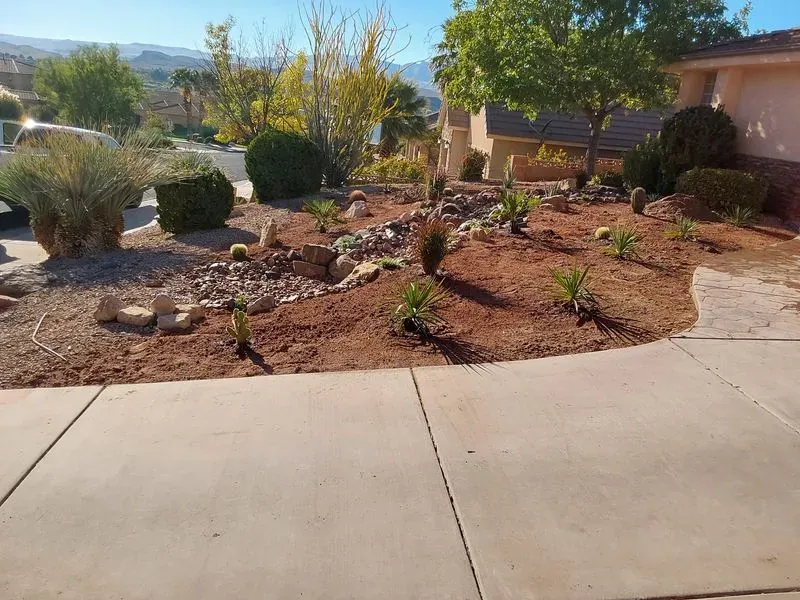
Nobody in this trade likes publishing numbers. Here are ours anyway, along with the three things that move a Southern Utah quote more than anything else.
Ask three landscapers what a job costs and you will get three ranges and no numbers. There is a reason for that. Every property is different and nobody wants to be held to a figure they quoted before seeing the site. But it makes it almost impossible for a homeowner to work out whether they are being quoted fairly, so here is what work actually costs in and around Saint George, with the caveats attached rather than hidden.
The short version
These are regional ranges for Washington County, drawn from published Utah and national cost data and from what we see quoted locally. They are a sanity check, not a quote.
| Work | Typical range | What moves it |
|---|---|---|
| Full desert conversion (xeriscape) | $4.50 to $15 per sq ft | Plant density, rock type, whether irrigation is rebuilt |
| Typical 1,000 sq ft front yard conversion | $5,000 to $12,000 before rebate | Boulder work and hardscape are the big swings |
| Sod installation | Priced per sq ft, plus prep | Soil prep and grading usually cost more than the sod |
| Paver patio or walkway | Priced per sq ft | Base depth, edge restraint, cuts and curves |
| Shrub & tree pruning | Per visit, by size and access | Height, whether debris is hauled, how overdue it is |
| Ongoing maintenance | Per visit on a schedule | Property size, visit frequency, what is included |
We quote every job on site and for free, so if your property does not look like the average one, the number will not either.
The three things that move a Southern Utah quote most
1. Whether your city pays you to remove lawn
This is the single biggest swing on a conversion, and it is decided entirely by your address. The Washington County Water Conservancy District's Water Efficient Landscape rebate pays $2 per square foot for the first 5,000 square feet of living, maintained grass removed, and $1 per square foot beyond that.
It is only available in four cities. St George, Washington, Santa Clara and Ivins. Because those four adopted the water-waste and new-construction landscape ordinances the District requires. Hurricane and La Verkin properties do not qualify.
On a 1,000 square foot front lawn in St George, that is $2,000 off the project. Santa Clara stacks an extra $1 per square foot on the first 500 square feet on top of the District's payment, which is the highest rate in Utah. We have written the eligibility and sequencing up in full in the rebate guide, including the part that catches people out: do not start work before your pre-conversion inspection, or none of it counts.
2. What is under the ground
A quote for planting eight trees assumes eight holes. If your property has a caliche hardpan at eighteen inches. Common right across the St George-Hurricane corridor. Those are not holes, they are eight augering jobs through cemented calcium carbonate. The same applies to the mass-graded newer subdivisions, where the topsoil was scraped off before building and what is left is compacted construction fill.
This is the most common reason two quotes for apparently the same job differ by thousands. One of them has accounted for the ground and the other is going to discover it on day two. It is also the most common reason new trees die here, which we cover in the soil article.
3. Whether the irrigation is being rebuilt or reused
Converting a lawn zone to a planted desert bed is not just a planting change. The District's rebate requires you to convert that zone from spray to drip, with filters, pressure regulators and emitters rated at 20 gallons per hour or less. If the existing system is sound, that is a manageable retrofit. If it is a 1970s Bloomington system on brass risers with three leaks and a valve nobody can find, it is a rebuild.
Reusing a failing system to save money on install day is the most expensive decision available in this climate. A single stuck valve in July costs more in dead plants than the repair would have.
Where people spend money they did not need to
- Converting the whole property at once. Usually the wrong move outside the rebate cities. The zones that cost the most water and deliver the least value. Park strips, side yards, steep slopes nobody walks on. Are where the return is. The back lawn the kids actually use can stay.
- Buying plants rated for the wrong elevation. Most nursery stock in this county is selected for St George. If you are in La Verkin at 3,816 feet, you are in a colder hardiness zone and some of it will not survive a hard winter. Replacing it twice costs more than choosing right once.
- Rock mulch with no plan for weeds. Gravel over bare soil is not a finished landscape, it is a seedbed with a delay. It also will not pass a rebate inspection, which requires 50% living plant cover at maturity.
- Hardscape built on a thin base. Our clay swells and shrinks with moisture. A patio on an under-compacted base telegraphs every seasonal movement within about two years, and relaying it costs more than building it properly did.
Where worth spending more
Three things reliably pay for themselves here: getting the irrigation right, breaking through caliche at planting rather than around it, and choosing plants for your actual elevation. None of them are visible on completion day, which is exactly why they get cut from quotes.
Everything you can see. The boulders, the flagstone, the plant sizes. Can be scaled up later. The things you cannot see cannot.
Getting a number for your property
We quote free and on site across Washington County. If the job is smaller than you think it is, we will say so. We would rather prune a hedge well this year and rebuild the yard when you are ready than talk you into both at once.
Cost ranges here are drawn from published 2026 Utah and national landscaping cost data and local market observation. Rebate figures are from the Washington County Water Conservancy District's Water Efficient Landscape program and were accurate when this was written. Rates and eligibility change, so confirm current terms with the District before planning around them.