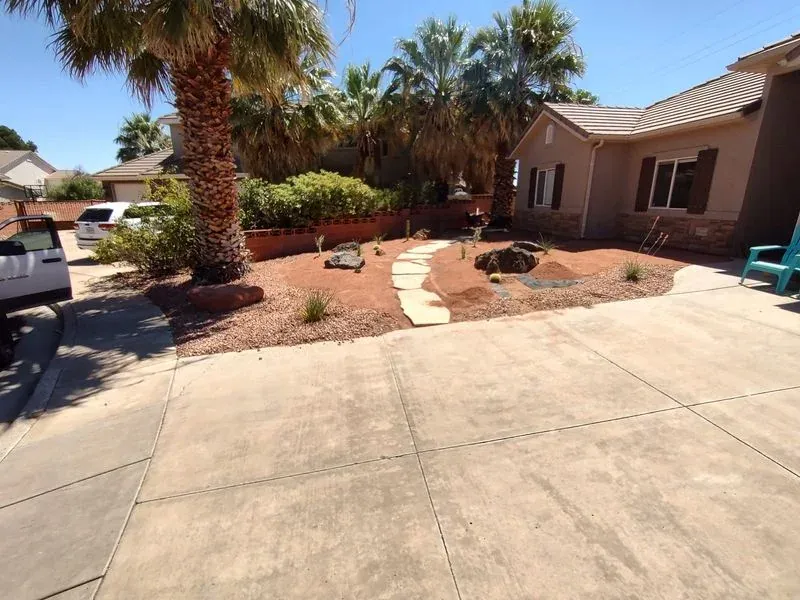
Most 'Southern Utah' plant lists are written for St George. If you live 900 feet higher in La Verkin, half of it is wrong. Here is a list that accounts for that.
There is a problem with almost every "best plants for Southern Utah" list you will find: it is written for St George. Nurseries here stock for St George too. And if you live in La Verkin, nearly a thousand feet higher and a full hardiness zone colder, a meaningful share of that advice will get your plants killed in the first hard winter.
So this list is sorted by the thing that actually determines survival here.
First, find your zone
| Town | Elevation | USDA zone | Avg. winter minimum |
|---|---|---|---|
| Washington City | 2,894 ft | 8b | 15 to 20°F |
| St George | ≈2,860 ft | 8b | 15 to 20°F |
| Santa Clara | ≈2,900 ft | 8b | 15 to 20°F |
| Ivins | 3,156 ft | 8b | 15 to 20°F |
| Hurricane | 3,258 ft | 8b | 15 to 20°F |
| La Verkin | 3,816 ft | 8a | 10 to 15°F |
If you are in La Verkin, or on a low-lying lot anywhere near the Virgin River corridor where cold air drains and settles on still nights, plant for 8a. A five-degree difference in the coldest night of the year is exactly the margin that decides whether a marginal plant survives.
Second, understand what else is working against you
Cold is only one constraint. Two others shape this list:
- Alkaline soil. Soil pH across the county typically runs 7.5 to 8.5. At that level iron and manganese are chemically locked up, which is why so many non-adapted trees here go yellow between the veins and never recover. Plants that evolved on limestone and caliche soils do not have this problem. More on that here.
- Reflected heat. Red sandstone, block walls and rock mulch store heat and radiate it back. A bed on a south or west wall can run far hotter than the air temperature, and a plant rated comfortably for your zone will scorch in it while the same species thrives on the north side. In Ivins this is the single biggest placement factor.
Trees
- Desert willow (Chilopsis linearis): long bloom, drought-adapted once established, handles alkaline soil without complaint. One of the most reliable small flowering trees here.
- Honey mesquite (Prosopis glandulosa): deep-rooted, tough, good filtered shade. Wants space and minimal pruning; shaping it hard ruins the form for years.
- Texas mountain laurel (Dermatophyllum secundiflorum): evergreen, slow, fragrant spring bloom. Excellent in alkaline ground. Slow enough that you should buy it bigger than you think.
- Chaste tree (Vitex agnus-castus): summer flowering, heat-indifferent, adaptable. A dependable mid-size shade option.
- Netleaf hackberry (Celtis reticulata): native to this region, handles heat, cold and bad soil. Unfashionable and undervalued.
Zone 8a note: mesquite and Texas mountain laurel are more marginal in La Verkin than in St George. Site them in a protected spot or choose hackberry and vitex instead.
Shrubs
- Apache plume (Fallugia paradoxa): native, feathery seed heads most of the season, thrives on neglect. One of the best true natives available.
- Fernbush (Chamaebatiaria millefolium): Utah native, aromatic, cold-hardy well past anything this county delivers. Safe at any elevation here.
- Sand sage (Artemisia filifolia): silver, fine-textured, excellent contrast against red rock and decorative gravel.
- Pink fairy duster (Calliandra eriophylla): soft pink puffs, low water, takes reflected heat well. Grown at the Red Hills Desert Garden.
- Globemallow (Sphaeralcea ambigua): orange bloom, native, self-seeds happily. Cut back hard after flowering.
- Rockrose (Cistus species). Mediterranean rather than native, but well adapted to alkaline soil and heat, with a long bloom.
Accents and succulents
- Agave: A. parryi and A. utahensis are the cold-hardy choices and the right ones for La Verkin. Softer Mexican species are a gamble above 3,500 feet.
- Yucca: Y. baccata, Y. filamentosa and Y. rostrata all perform. Structural, evergreen, effectively indestructible.
- Red yucca (Hesperaloe parviflora): not a true yucca. Long coral bloom spikes, hummingbirds, extremely tolerant. Probably the single most dependable accent plant in this county.
- Prickly pear (Opuntia): native, cold-hardy, free if a neighbor has one. Site it away from paths.
- Ocotillo (Fouquieria splendens): dramatic and architectural, but marginal for cold here. St George and Washington City only, in a warm spot.
Grasses and groundcovers
- Deergrass (Muhlenbergia rigens): large, clean, good structure through winter.
- Blue grama (Bouteloua gracilis): native bunchgrass, can be mown as a low-water lawn alternative, fully cold-hardy.
- Damianita (Chrysactinia mexicana): low yellow-flowering evergreen mound, excellent along paths.
- Penstemon: several species do well; Palmer's and firecracker penstemon are widely grown here and both are at the Red Hills Desert Garden.
Go and look at them first
The Red Hills Desert Garden on Red Hills Parkway in St George is the best reference in the county and it is free. Over 5,000 water-efficient plants, all labelled, open daily from 6 a.m. to 10 p.m. Every species is one that has been deliberately trialled for this region, and the plants are mature enough to show you their real size rather than their nursery-pot size.
We send clients there before finalising designs. Photographs and plant tags are one thing; standing next to a fifteen-year-old specimen and deciding whether you want that much of it next to your front door is another.
Two mistakes to avoid
Assuming native means no water. Everything on this list needs establishment watering. Typically two to three years of regular drip before it can fend for itself. Cutting water in year one is the most common reason new desert landscapes fail here. District guidance for drip zones is 20 to 40 minutes on high-flow emitters or 30 to 90 on low-flow, and that applies to natives too.
Planting for the pot size. Desert plants are usually sold small and get large. A five-gallon desert willow becomes a twenty-five foot tree. Spacing a bed to look full on install day guarantees you are removing half of it in six years. If you want it to look full immediately, use more groundcover and fewer shrubs, not tighter shrub spacing.
Hardiness zones are USDA. Species performance notes reflect our own experience working across Washington County plus plantings trialled at the Red Hills Desert Garden. If you are in Kayenta, check the ACC's own approved plant guide before finalising anything. See the HOA article.