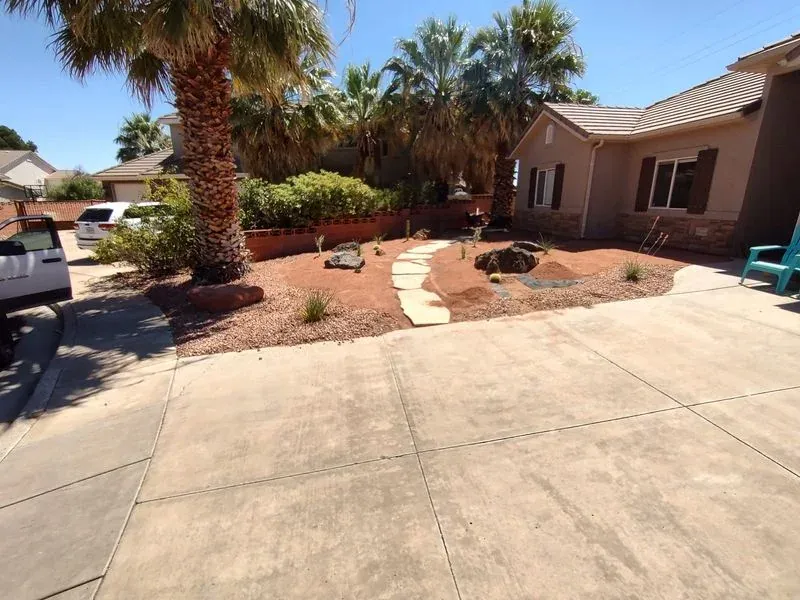
In Kayenta, landscaping without written approval can be ordered out at your cost. Here is how the process actually works, and how it interacts with the rebate deadline.
There is a specific, expensive mistake available to anyone landscaping in Kayenta: doing the work first and seeking approval afterwards. The covenants do not permit it, and unapproved work can be required to come out at the owner's cost. This article is about how the process actually runs, and how to sequence it against a rebate deadline without the two colliding.
Ivins: the Kayenta ACC
Kayenta is not one homeowners association. It is four. Kayenta Homesites, Kayenta Lake Patio Homes, Shonto Point and Taviawk. And all of them operate through an Architectural Control Committee.
The ACC's requirement is stated plainly in the community's rules: any change to the exterior of a home must be approved before any changes can be made or started. The list of what counts is explicit and it names landscaping and re-landscaping alongside construction, painting, roofing and additions.
In other words, replanting a front bed is treated the same way as adding a room. Not because the committee is being difficult, but because in a community whose whole premise is a consistent native-desert character, landscaping is the architecture.
What the committee is actually looking for
The guiding principle is retaining the native landscape. The comparison Kayenta uses for itself is a national park. The aim is that the built environment recedes and the desert reads as continuous across property lines. Practically, that means:
- Regionally adapted and native species rather than imported ornamentals
- Planting that blends into the surrounding desert rather than framing the house
- Materials and rock that match the local palette
- No conspicuous lawn-and-hedge geometry
The ACC Landscaping Committee publishes a plant guide listing currently suggested species, with mature height and width, growth rate, and, most usefully, which local nurseries actually stock them. If you are planning anything in Kayenta, that document is where to start. It is available through the Kayenta HOA website.
The dues are around $500 a year, which is low for a community with this level of design control. The trade-off is that the control is real and consistently applied.
The practical sequence
- Design the plan against the approved plant guide, with mature sizes accounted for.
- Submit to the ACC and wait for written approval.
- Then start work.
A contractor who tells you approval is a formality to sort out later is telling you they have not done this before. We prepare and submit the plan as part of the job rather than handing it back to the homeowner.
The collision nobody warns you about
The short version that catches people in Ivins specifically: Ivins is one of the four cities eligible for the Water Conservancy District's turf removal rebate, along with St George, Washington and Santa Clara.
So a Kayenta turf conversion has two separate approval processes, run by two organisations with no knowledge of each other:
| Kayenta ACC | Water Conservancy District | |
|---|---|---|
| Approves | Design, plant palette, character | Rebate eligibility, irrigation spec |
| Required before work? | Yes | Yes. Pre-conversion inspection |
| Typical wait | Committee schedule | Call within ~14 business days |
| If you start early | Work can be ordered removed | Rebate forfeited entirely |
Both must be in hand before a shovel moves. Get ACC approval and start without the District's pre-conversion inspection and you lose the $2 per square foot. Get the District's inspection and start without the ACC and you may be putting it back.
They also constrain each other. The District requires at least 50% living plant cover at maturity using water-efficient vegetation, and conversion from spray to drip with pressure regulators, filters and emitters rated at 20 gallons per hour or less. The ACC requires a native-character palette. A design that satisfies one and not the other fails overall. Which is an argument for designing to both from the start rather than adapting a plan halfway through. Fortunately the two pull in broadly the same direction here: a native, water-wise palette is what both want.
Santa Clara: different rules, different opportunity
Santa Clara is not subject to anything like the Kayenta ACC. There are HOAs in some of the newer subdivisions with their own standards, and it is always worth checking yours, but the town does not have a community-wide architectural committee governing landscaping.
What Santa Clara has instead is money. The city adds $1 per square foot on the first 500 square feet on top of the District's standard $2. Which the District itself describes as making Santa Clara the highest-paying place in Utah for removing nonfunctional turf.
That top-up comes from a finite allocation. The city put in roughly $82,000, and state matching brought the pot to around $164,000. Enough for about 320 residential conversions. When it is spent, the top-up ends until it is funded again. Full detail in the rebate guide.
Santa Clara also has a historic district along Santa Clara Drive with old streetscape and heritage plantings. There is no ACC telling you what to do there, but a gravel-and-agave scheme that looks right in Kayenta can look distinctly wrong in front of an 1800s stone house. Worth designing for the street you are actually on.
Elsewhere in the county
Most other HOAs in Washington County are lighter touch than Kayenta but not absent. Coral Canyon and Sienna Hills in Washington City both have landscape standards, as do several Hurricane and St George subdivisions. Entrada in Ivins has its own controls.
The general rule: if you are in a master-planned community built after about 2000, assume there is a landscape standard and check before you plan. The cost of asking is a phone call. The cost of not asking can be the whole job.
What we do about it
For Ivins and Kayenta work we treat the ACC submission as part of the job. That means designing from the approved plant guide, preparing the submission, and where a rebate is involved, sequencing the District's inspection and the ACC's approval so neither blocks the other. It is not glamorous work, but it is the difference between a project that goes smoothly and one that stops halfway.
Kayenta ACC requirements are summarised from the Kayenta HOA's published rules and Architectural Control Committee materials. Rebate terms are from the Washington County Water Conservancy District's Water Efficient Landscape program. Both change. Verify current requirements with the ACC and the District before planning around them.