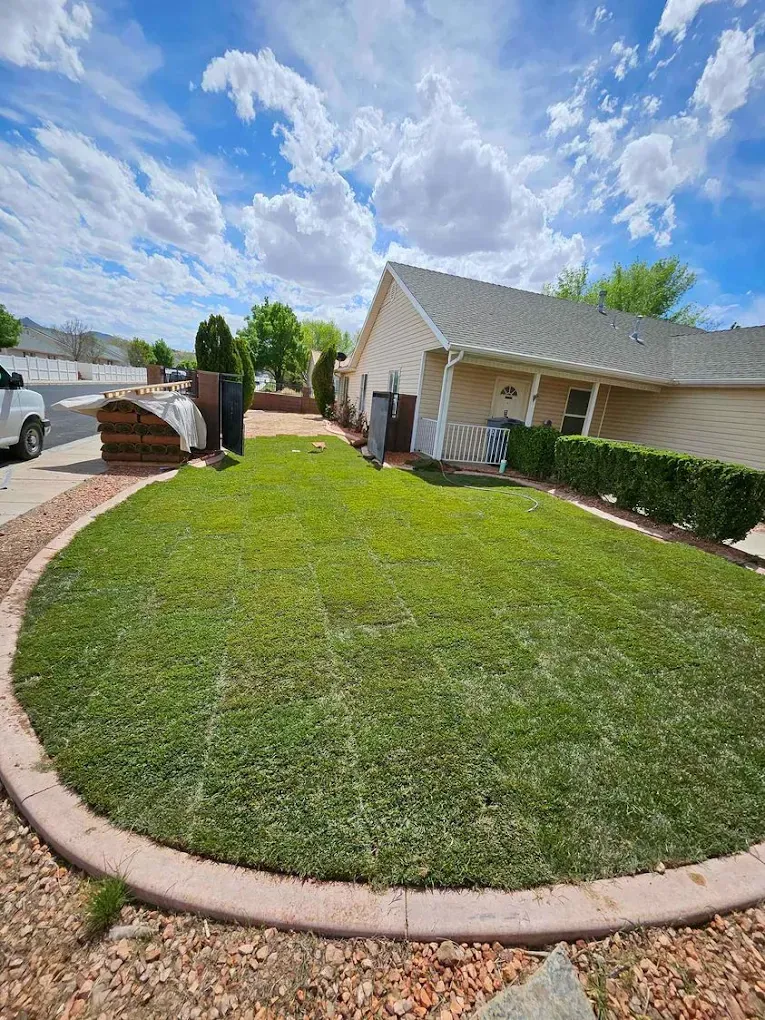
Your lawn is not dying because you are watering too little. In most Washington County yards it is dying because the grass species was never built for a July here.
Every July we get the same call. The lawn was fine in May, started thinning in late June, and now there are straw-colored patches spreading from the edges. The homeowner has usually responded by watering more, which has made it worse. Here is what is actually happening.
The root cause: the wrong grass for this climate
Most lawns in Washington County are cool-season grass. Kentucky bluegrass or tall fescue. Those species evolved for climates where summer soil temperatures sit in the sixties and seventies. Peak summer soil temperature in St George averages around 98°F.
At that soil temperature, cool-season grass is not growing. It is surviving. Root growth effectively stops above the mid-eighties, so the plant is running on whatever root system it built in spring while losing water faster than those roots can supply. The visible result is thinning, then browning, then bare patches. Usually starting at edges, slopes and anywhere near hot concrete, because those dry first.
This is not a disease and it is usually not neglect. It is a species mismatch that only shows up for eight weeks a year.
Why watering more makes it worse
The instinct is to increase run time. In our soil that backfires for two reasons.
First, our ground cannot absorb water as fast as a spray head delivers it. Washington County soils are predominantly alkaline clay, often with a caliche layer underneath. Clay has a very low infiltration rate. Run a spray zone for twenty minutes straight and most of the back half of that runs off down the gutter. You have paid for the water, the lawn has not received it, and the part that did soak in stayed in the top two inches.
Second, shallow frequent watering builds shallow roots. If water is always available in the top inch, roots have no reason to go deeper. Then July arrives, the top inch dries out in an afternoon, and the plant has nothing below it to fall back on.
The District's recommendation is cycle-and-soak: three cycles per watering day, five minutes for fixed spray nozzles or ten for rotating spray, with about an hour between cycles. Same total water, delivered at a rate the soil can actually take. We go into the full schedule in the watering rules article.
The four things worth checking first
- Is it the whole lawn or a pattern? Straight-edged dead strips or circles are almost always irrigation coverage, not heat. A clogged nozzle, a tilted head or a zone with pressure problems shows up as geometry. Heat stress is diffuse and starts at the edges.
- Are you watering in the legal window? Most cities here prohibit landscape irrigation between 10 a.m. and 8 p.m. in summer. Beyond the rule, midday watering loses a large share to evaporation before it reaches the root zone. Preferred window is around 10 p.m. to 3 a.m.
- How short are you mowing? USU's St George calendar recommends 2.5 to 3 inches minimum, and never removing more than a third of the blade at once. Short grass means less leaf area, hotter soil and shallower roots. Everything you do not want in July. Raising the mower is the cheapest fix available.
- Has it been aerated? Compacted clay makes every watering problem worse. The recommended timing here is March and September for cool-season grass, April and September for warm-season.
The four real fixes
1. Raise the mower and fix the irrigation
Cheapest, fastest, and it resolves a meaningful share of the lawns we look at. Mow at 3 inches, switch to cycle-and-soak, and repair the coverage gaps. Many "dying" lawns are simply not receiving water in the places that are dying.
2. Change the species
If you want a lawn that is comfortable in a Southern Utah July, a warm-season grass is the honest answer. Bermuda and zoysia thrive at the soil temperatures that shut cool-season grass down. The trade-off is real: they go dormant and brown in winter, which some people cannot live with.
Tall fescue is the most heat-tolerant of the cool-season options and a reasonable compromise if year-round green matters to you. Kentucky bluegrass is the least suited to this climate of the common choices.
Timing for a change matters. See the sod timing article, because there is one month here you should not do it in.
3. Shrink the lawn to the part you use
This is what we end up recommending most often, and it is not a sales pitch for a bigger job. It is usually a smaller one. Most properties here water a lot of grass that nobody ever stands on: park strips, side yards, the strip along the driveway. That turf has all the July problems and none of the benefits.
Keep the back lawn the kids and the dog actually use. Convert the rest. In St George, Washington, Santa Clara and Ivins the Water Conservancy District will pay $2 per square foot toward exactly that. Details in the rebate guide.
4. Accept summer dormancy
Worth saying, because it is a legitimate option nobody offers. Cool-season grass going brown in July is not necessarily dead. It is dormant, and it will often green up in September on its own. If you can tolerate two brown months, you can water substantially less and let it ride. It is not the right answer for everyone, but it is a real one.
What we would look at on your property
In order: irrigation coverage and run pattern, mowing height, soil compaction, then species. Three of those four are cheap to fix and one is not, so that is the order they are worth checking in. We will tell you honestly if the answer is "raise your mower and fix the third zone" rather than quoting you a new lawn.
Soil temperature, mowing height, fertilisation and aeration timings are from USU Extension's St George turfgrass management calendar. Irrigation cycle guidance is from the Washington County Water Conservancy District's watering guide.