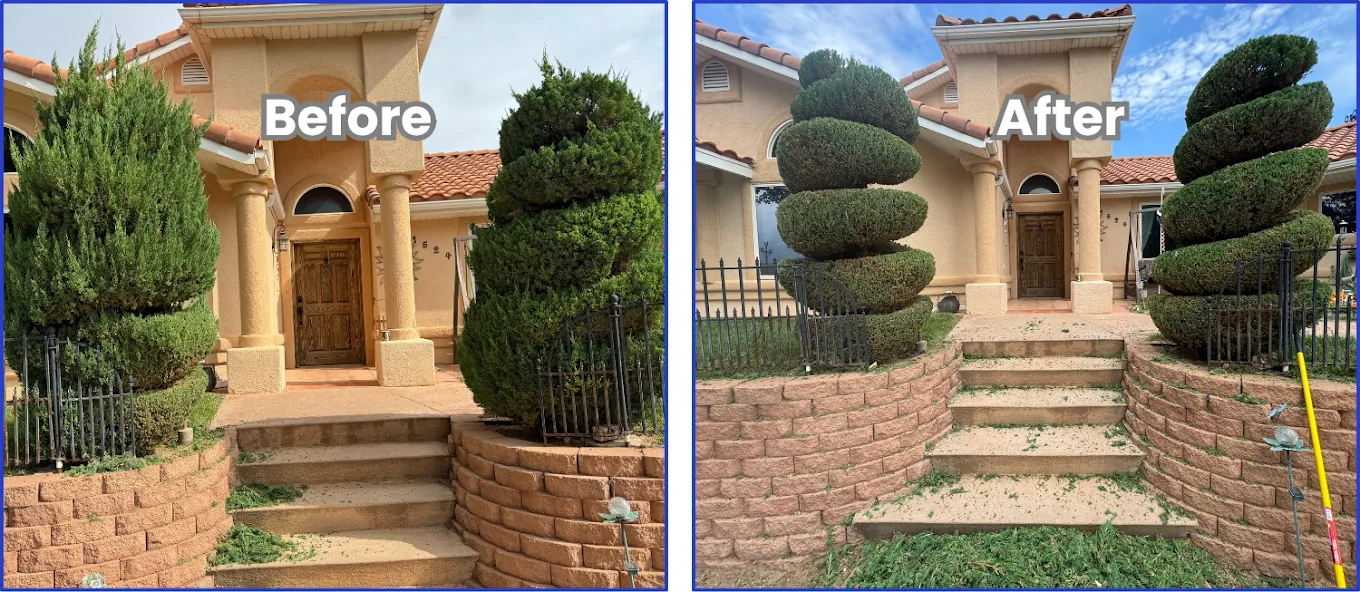
Prune at the wrong time here and you do not just lose flowers. You push tender growth straight into a frost. The window is narrower than most people think, and it moves with your elevation.
Pruning is the one job where doing it at the wrong time is worse than not doing it at all. Cut a spring-flowering shrub in February and you remove every flower bud it made last summer. Cut anything in October and you push soft new growth that will not harden before the first frost. Both mistakes are easy, both are common here, and both are avoidable once you know the shape of the year.
The general rule for Southern Utah
Late winter, while the plant is dormant but close to bud break. For most of Washington County that means February into early March. The plant is not actively growing, so the cut does not bleed sap or invite stress, but it is close enough to spring that wounds seal quickly once growth resumes.
Southern Utah can go earlier than the rest of the state. Northern Utah advice built around Salt Lake or Logan assumes dormancy breaks in late March or April. Ours breaks weeks sooner, which is why guidance written for "Utah" generally runs late for us.
Your elevation moves the date
This is the part most pruning advice skips, and in this county it matters more than almost anywhere. The towns we work in span nearly a thousand feet of elevation, and the calendar moves with it.
| Town | Elevation | Zone | Typical pruning window |
|---|---|---|---|
| Washington City | 2,894 ft | 8b | Early-mid February |
| St George | ≈2,860 ft | 8b | Early-mid February |
| Santa Clara | ≈2,900 ft | 8b | February |
| Ivins | 3,156 ft | 8b | Mid-late February |
| Hurricane | 3,258 ft | 8b | Late February-early March |
| La Verkin | 3,816 ft | 8a | March |
La Verkin is the outlier and worth understanding why. At 3,816 feet it sits in USDA hardiness zone 8a rather than 8b. Average annual minimum temperatures of 10 to 15°F against 15 to 20°F down the hill. Prune there on a St George schedule and you are inviting new growth out into a frost that Washington City will not get. A few weeks of patience costs nothing; a late freeze on fresh growth costs a season.
The shrubs that break the rule
Anything that flowers before June gets pruned after it blooms, not before. Spring-flowering shrubs set their flower buds during the previous summer. Those buds are sitting on the plant all winter. Prune in February and you cut them off, then wonder in April why nothing flowered.
The safe version of the rule: if it blooms on wood that grew last year, prune it immediately after flowering finishes. If it blooms on this season's new growth, late winter is fine.
Roses are their own case. Wait until the buds begin to swell before cutting. That is the plant telling you the frost risk has passed. Going by the calendar instead of the plant is how people lose rose growth to a late freeze here.
Why autumn pruning is a mistake here
It feels sensible. The garden is winding down, you have time, and everything looks scruffy. But a pruning cut is a growth signal. Cut in September or October and the plant responds by pushing new shoots. Soft, thin-walled tissue with no time to harden off before the first frost. That growth dies, and the dieback often runs further back than the new growth did.
In La Verkin and Hurricane, where frost arrives earlier and harder than in St George, this is a expensive mistake rather than a cosmetic one. Leave it. The scruffy look gets cleared in the spring cleanup instead.
Desert and native plants want less, not more
Mesquite, acacia, desert willow, native junipers and the rest of the water-wise palette do not want an annual haircut. Their form is the point, and over-pruning ruins it for years. You cannot put branch structure back.
A two to three year cycle of light structural work is usually right for these. This matters especially in Ivins and Kayenta, where the landscape standard is native character and a plant sheared into a ball is working against the whole scheme.
What "structural pruning" actually means
Most of what people call pruning around here is shearing. Running a hedge trimmer over the outside of a shrub. It produces a tidy shell and a dead, twiggy interior, and every year the shell has to get bigger because that is the only place with leaves.
Structural pruning removes whole branches back to a junction, opening the plant so light reaches the inside. It takes longer, it looks less dramatic on the day, and the plant is smaller and healthier three years later rather than larger and hollower. On a fifty-year-old juniper in Bloomington or an overgrown pair of entry shrubs, this is the difference between restoration and slow decline.
It is also reversible in the sense that shearing is not. Once a shrub has been sheared for a decade, bringing it back is a three-season project.
Quick reference
- February (low elevation) / March (La Verkin): structural pruning of dormant trees and summer-flowering shrubs.
- When rose buds swell: roses.
- Right after flowering finishes: anything that bloomed before June.
- Any time: dead, damaged or hazardous wood. This never waits.
- Never: autumn, on ornamental trees and shrubs.
- Every 2 to 3 years, lightly: desert natives and adapted species.
Pruning is the work we are best known for in Washington County, and the reason is that most crews mow and comparatively few know how to bring an overgrown specimen back without wrecking it. If something on your property has got away from you, late winter is when to deal with it.
Timing guidance here follows USU Extension recommendations for Utah, adjusted for the elevation range across Washington County. Hardiness zone figures are USDA. Your specific microclimate. A low-lying lot, a south-facing wall. Can shift these dates by a week or two in either direction.